If you’re considering enhancing your smile, you may have encountered porcelain veneers vs composite bonding. Both treatments can significantly improve the appearance of your teeth, but porcelain veneers and composite bonding treatments work differently and have distinct advantages and disadvantages.
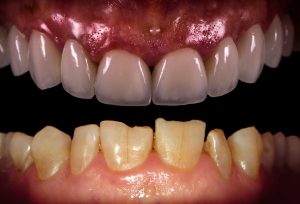
How Do Porcelain Veneers Work?
- Process: Thin, custom-made shells, usually porcelain or composite resin, are bonded to the front surface of your teeth.
- Procedure: Your dentist removes a thin layer of enamel, takes an impression, and sends it to a dental lab. Once the veneers are fabricated, they’re bonded to your teeth.
How Does Composite Bonding Work?
- Process: A tooth-coloured resin material is applied directly to your teeth, shaped, and hardened with a special light.
- Procedure: Your dentist cleans your teeth, applies the resin, and molds it to the desired shape.
What Can Porcelain Veneers Repair?
- Chipped or cracked teeth
- Discoloured teeth
- Gaps between teeth
- Misaligned teeth
- Worn-down teeth
What Can Composite Bonding Repair?
- Chipped or cracked teeth
- Gaps between teeth
- Discoloured teeth
- Worn-down teeth
- Minor tooth shape and size issues
Who is Suitable for Porcelain Veneers or Composite Bonding Treatment?
- Porcelain Veneers: Ideal for individuals seeking a long-lasting, highly aesthetic solution for significant tooth imperfections.
- Composite Bonding: Suitable for those with minor cosmetic issues who prefer a less invasive, more affordable option.
Porcelain Veneers vs Composite Bonding Treatments:
Pros and Cons of Porcelain Veneers
Pros
- Durability: Long-lasting, can last 10-15 years with proper care.
- Stain Resistance: Highly resistant to stains from coffee, tea, and wine.
- Natural Appearance: Can be customized to match your natural teeth.
- Versatility: Can correct a variety of dental issues, including chips, cracks, discoloration, and gaps.
Cons
- Cost: More expensive than composite bonding.
- Irreversible: Once bonded, they cannot be removed.
- Tooth Preparation: Requires removal of a small amount of tooth enamel.
- Sensitivity: Some patients may experience temporary sensitivity after the procedure.
Pros and Cons of Composite Bonding
Pros
- Cost-Effective: Less expensive than veneers.
- Less Invasive: In most cases no tooth preparation required.
- Reversible: Can be removed if desired.
- Quick Procedure: Can often be completed in a single appointment.
Cons
- Durability: Less durable than veneers, may need replacement every 5-7 years.
- Stain Prone: More susceptible to staining than veneers.
- Less Natural Appearance: May not be as natural-looking as porcelain veneers.
- Limited Versatility: Best suited for minor cosmetic issues.
What Happens During Porcelain Veneers and Composite Bonding Treatments?
Porcelain Veneers:
- Consultation: Your dentist will discuss your goals and assess your oral health.
- Preparation: Your dentist will remove a thin layer of enamel from the front of your teeth.
- Impression: An impression of your teeth is taken to create custom veneers.
- Temporary Veneers: Temporary veneers may be placed to protect your teeth.
- Veneer Placement: The permanent porcelain veneers are bonded to your teeth.
Composite Bonding:
- Consultation: Your dentist will discuss your goals and assess your oral health.
- Preparation: Composite bonding may be undertaken by a dentist or impressions taken and created by a smile design laboratory.
- Resin Application: The composite resin is applied to your teeth, shaped, and hardened with a special light. (If undertaken in 1 visit)
- Polishing: The composite resin is polished to achieve a smooth, natural-looking finish.
Choosing the Right Porcelain Dental Veneer or Composite Bonding Treatment
To determine the best treatment for you, consider the following factors:
- Severity of the issue: For significant imperfections, veneers are often the best choice. For minor issues, composite bonding may suffice.
- Desired outcome: If you’re looking for a long-lasting, highly aesthetic solution, veneers are a great option. If you prefer a more conservative approach, composite bonding may be a better fit.
- Budget: Veneers are generally more expensive than composite bonding.
- Lifestyle: If you consume a lot of staining substances, veneers may be a better option.
St Paul’s Square Dental Practice: Your Address for Perfect Smiles
At St Paul’s Square Dental Practice in Birmingham, we offer both porcelain veneers and composite bonding to help you achieve your smile goals. Our experienced dentists will work with you to determine the best treatment option for your specific needs.
Contact us today to schedule a consultation in Birmingham and take the first step towards a more beautiful smile. To book a appointment 7/24 online you can click here.